



















Top, Middle & Base Notes: How a Fragrance Evolves on Your Skin
Top, middle and base notes, explained in one minute
Top notes are what you smell in the first few minutes — bright, volatile and fleeting. Middle notes (also called the heart) emerge as the top fades and form the main character of the scent for a few hours. Base notes are the heaviest, slowest molecules; they anchor the fragrance to your skin and can linger well into the next day. Together these three layers are called the fragrance pyramid, and they are the reason a perfume smells different the moment you spray it versus hours later.
Understanding this simple structure is the single most useful thing you can learn about perfume. It explains why a scent you loved on a paper strip can feel different by lunchtime, how to test a fragrance properly before buying, and why some perfumes last all day while others disappear by noon. Below we break down each layer, then walk through three AMOUR fragrances so you can smell the theory in action.
Why a fragrance changes over time
A perfume is a blend of dozens of aromatic materials, each with a different volatility — how quickly it evaporates. Light molecules lift off your skin first; heavy ones cling for hours. Perfumers arrange these deliberately so a scent unfolds like a story with a beginning, a middle and an end. This unfolding is called the dry-down, and it is why experienced buyers never judge a fragrance in the first thirty seconds.
Top notes: the first impression (0–15 minutes)
Top notes are the opening. They are usually fresh, sharp and energetic — think citrus, aromatic herbs, light spices and green accords. Their job is to grab your attention, but because they are so volatile they also fade fastest. If a perfume smells thrilling for five minutes and then seems to vanish, you were simply smelling the top notes evaporate. That is normal, not a flaw.
Middle notes: the heart (15 minutes–3 hours)
As the top notes lift away, the heart takes over. This is the true personality of the fragrance and the part you will wear for most of the day. Florals, softer spices, fruits and lush green notes usually live here. When someone describes a perfume as "a rose scent" or "a jasmine scent", they are almost always describing its heart.
Base notes: the lasting memory (3 hours onward)
Base notes are the foundation. Rich, heavy and slow to evaporate, they include woods, amber, vanilla, musk, resins and tobacco. They give a fragrance depth, warmth and staying power, and they are what you smell on a scarf the next morning. Base notes also "fix" the lighter notes, slowing everything down so the whole composition lasts longer.
How to smell the pyramid for yourself
- Spray on skin, not just paper. Your body heat drives the dry-down. A blotter shows the opening but never the true base.
- Wait. Re-smell at 15 minutes, at 1 hour and at 4 hours. You are tracking the top, the heart and the base in turn.
- Test one or two scents at a time. More than that and your nose fatigues and blends everything together.
- Give it a full day before deciding. The base note is what you actually commit to.
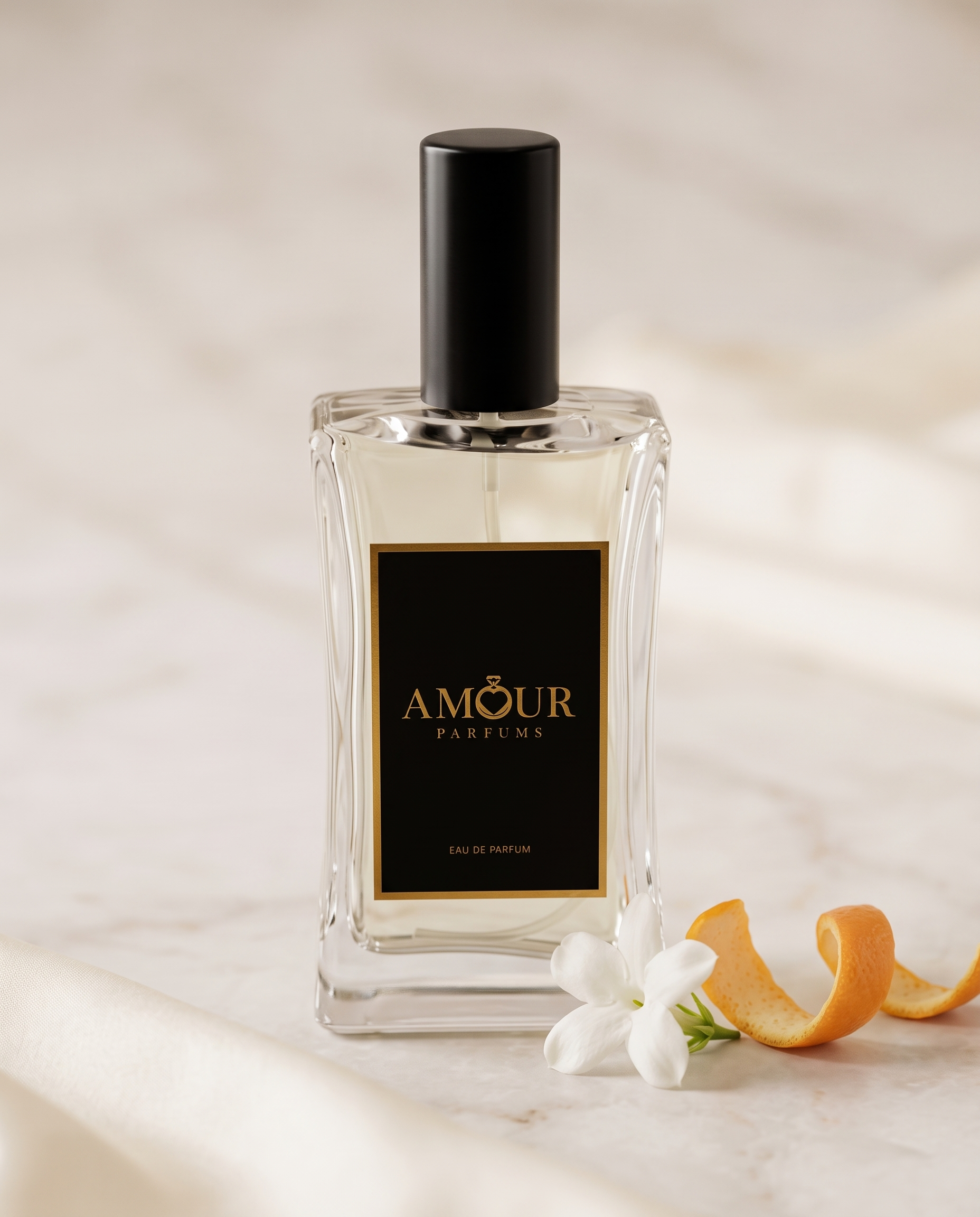
The fragrance pyramid in three AMOUR scents
Theory is easier to remember when you can smell it. Each of these fragrances shows the top–heart–base structure clearly, and each suits a different taste. We describe them purely by their notes and accords, and note who each one is designed for.
A luminous white-floral journey — AMOUR No. 5 (women's fragrance)
AMOUR No. 5 is a textbook example of the pyramid. It opens with sparkling ginger, bitter orange and bergamot; the heart blooms into creamy tuberose, orange blossom and jasmine; and it settles onto a soft base of sandalwood and vanilla. Spray it and you can almost set your watch by the way the bright citrus gives way to white flowers and finally to a warm, skin-like drydown. It is a women's fragrance in the fresh white-floral family.
A fresh-to-leather evolution — AMOUR No. 208 (men's fragrance)
AMOUR No. 208 shows how dramatic a dry-down can be. The top is crisp and green — lavender, chamomile, mandarin and lemon; the heart turns floral with violet, carnation and jasmine; and the base lands on vetiver, sandalwood, leather, amber and musk. You experience it as a clean, breezy opening that matures into something confident and leathery. It is a men's fragrance for anyone who likes a woody, leathery finish.
A sweet, gourmand slow-burn — AMOUR No. 200 (unisex fragrance)
AMOUR No. 200 proves the pyramid is not only about fresh openings. It begins with tobacco leaf and warm spices, moves through a heart of vanilla, cacao, tonka bean and tobacco blossom, and rests on dried fruits and woody notes. Because so much of its character sits in rich heart and base materials, it feels cosy and long-lasting from early on. It is a unisex fragrance in the sweet, gourmand-woody family.
You can explore the full range in our complete collection, where every fragrance lists its notes so you can predict how it will evolve before you ever spray it.
Frequently asked questions
Are top, middle and base notes the same as the ingredients list?
No. The pyramid describes when you smell certain notes, not a legal ingredients list. A single material can even bridge two layers. The pyramid is a perfumer's map of how the scent reveals itself over time.
Why did my perfume smell amazing at first and then weaker?
You smelled the top notes evaporate. This is expected. Wait for the heart and base to develop — the fragrance has not disappeared, it has simply moved to its next stage.
Which notes make a fragrance last longest?
Heavy base notes such as woods, amber, vanilla, musk and resins. Fragrances built around these tend to have the strongest staying power, which is why long-lasting scents often feel warm and deep.
How long should I wait before deciding to buy?
Ideally a full day on skin. At minimum, give it four hours so you experience the base note you will actually be wearing.
Do men's, women's and unisex fragrances follow the same structure?
Yes. The top–heart–base pyramid applies to every fragrance regardless of who it is designed for. Only the choice of notes changes.
The takeaway
Every perfume tells a three-part story: a bright top, a characterful heart and a lasting base. Once you can hear that story, testing and choosing a fragrance becomes far easier — you stop judging the first spray and start appreciating the whole arc. Next time you try a scent, set a timer, revisit it through the day, and let the pyramid reveal itself. To see the structure spelled out for each scent, browse the AMOUR collection and read the notes before you choose.